
Animals are multicellular eukaryotic organisms that form the biological kingdom Animalia. Animals consume organic material, breathe oxygen, are able to move, can reproduce sexually, and grow from a hollow sphere of cells, the blastula, during embryonic development. The wildlife of Pakistan comprises a diverse flora and fauna in a wide range of habitats from sea level to high elevation areas in the mountains, including 177 mammal and 660 bird species.
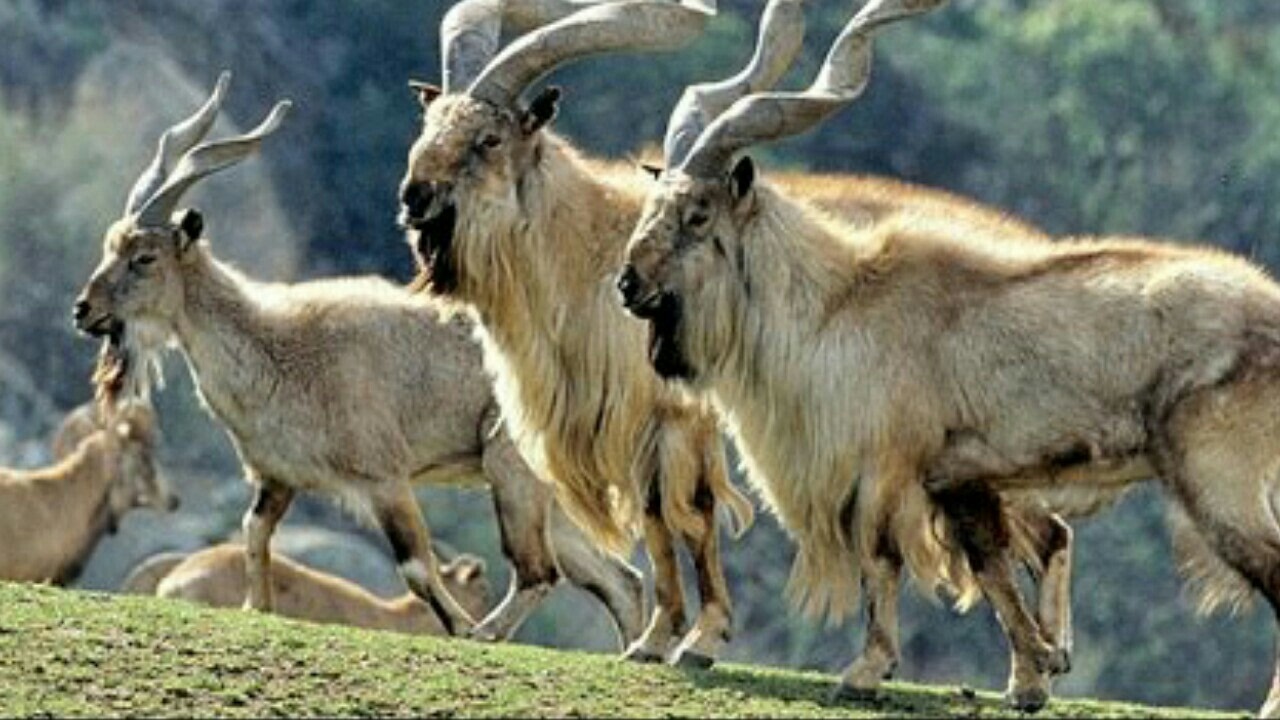
The northern highlands include lower elevation areas of Potohar and Azad Jammu and Kashmir regions and higher elevation areas embracing the foothills of Himalayan, Karakorum and Hindu Kush mountain ranges. Some of the wildlife species found in northern mountainous areas and Pothohar Plateau include the bharal, Eurasian lynx, Himalayan goral, Marco Polo sheep, marmot (in Deosai National Park) and yellow-throated marten and birds species of chukar partridge, Eurasian eagle-owl, Himalayan monal and Himalayan snowcock and amphibian species of Himalayan toad and Muree Hills frog. Threatened species include the snow leopard, Himalayan brown bear, Indian wolf, Rhesus macaque, Markhor, Siberian ibex, white-bellied musk deer. Bird species present are cheer pheasant, peregrine falcon and western tragopan.
The Indus plain and deserts of Sindh include some of the non-threatened mammal species includes the nilgai, red fox and wild boar, bird species of Alexandrine parakeet, barn owl, black kite, myna, hoopoe, Indian peafowl, Indian leopard, red-vented bulbul, rock pigeon, shelduck and shikra, reptile species of Indian cobra, Indian star tortoise, Sindh krait and yellow monitor and amphibian species of Indus Valley bullfrog and Indus Valley toad. Some of the threatened mammal species include the, axis deer, blackbuck (in captivity; extinct in wild), hog deer, dholes, Indian pangolin, Punjab Uriel and Sindh ibex, bird species of white-backed vulture and reptile species of black pond turtle and gharial. Grey partridge is one of the few birds that can be found in the Cholistan desert. The Tharparkar desert supports a fair population of the Chinkara.
Western region of Pakistan, most of which is enveloped in Balochistan province, has a complex geography. The Balochistan leopard has been described from this region. Some of the mammal species include the caracal, Balochistan dormouse, Blanford’s fox, dromedary camel, Indian crested porcupine, long-eared hedgehog, markhor, ratel, and striped hyena, bird species of bearded vulture, houbara bustard and merlin, reptile species of leopard gecko and saw-scaled viper and amphibian species of Balochistan toad.
There are a number of protected wetlands in Pakistan. The vegetation of Indus River Delta is mainly represented by various mangrove species and bamboo species. The wetlands are a habitat for migratory birds such as dalmatian pelicans and demoiselle crane as well as predatory species of osprey, common kingfisher, fishing cat and leopard cat near the coast line. West coast of Great Rann of Kutch, east to the Indus River Delta and below Tharparkar desert, is one of the few places where greater flamingos come to breed. These provide nesting grounds for common snakehead, giant snakehead, Indus baril and many species of catfish like rita. Sindh are nesting sites for five endangered species of sea turtles: green sea, loggerhead, hawksbill, olive ridley and leatherback. Sea snakes such as yellow-bellied sea snake are also found in the pelagic zone of the sea. The wetlands of Pakistan are also a home to the mugger crocodile who prefer freshwater habitat.
 View of Nature