
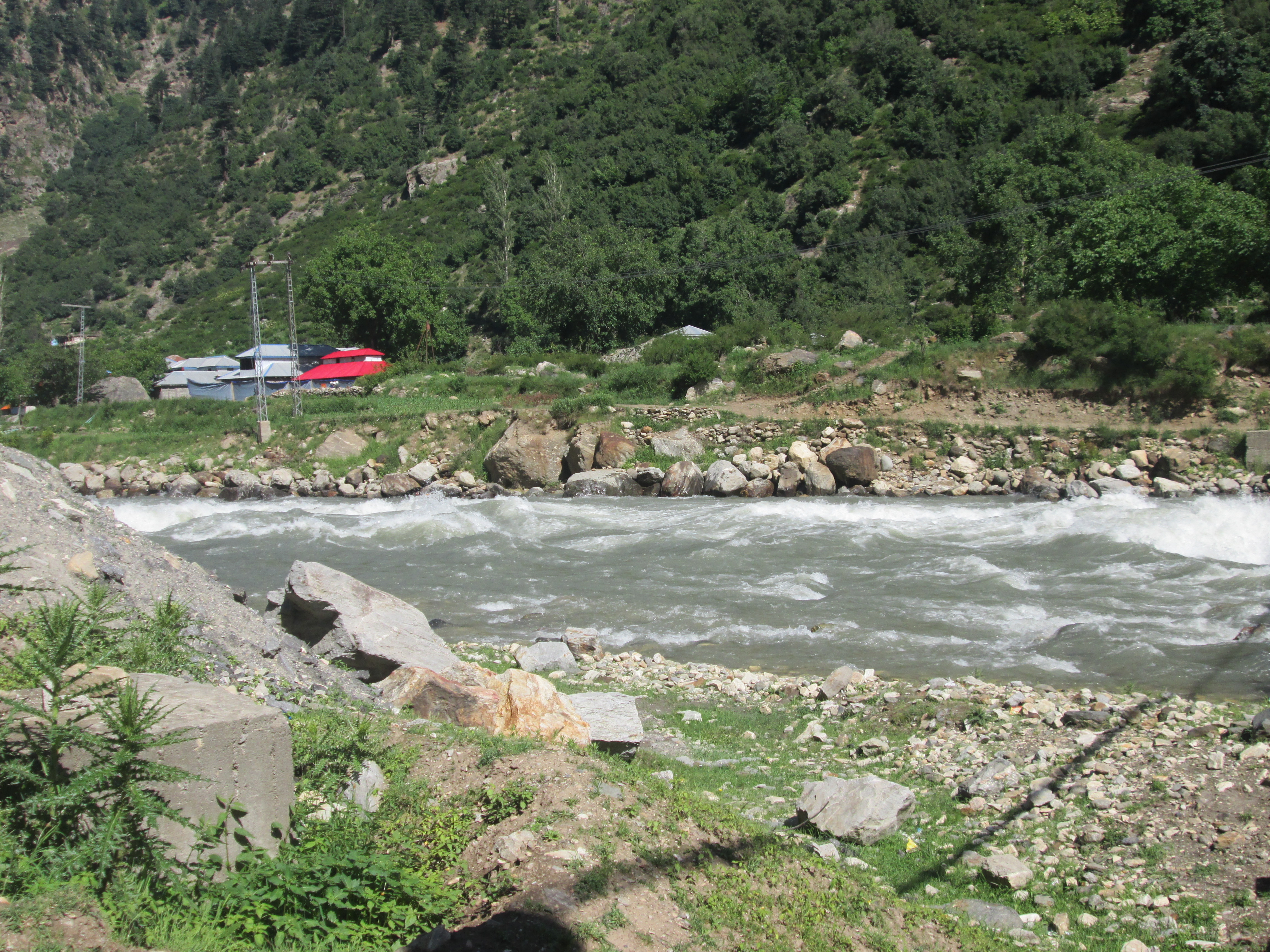
A river is a natural flowing watercourse, usually freshwater, flowing towards an ocean, sea, lake or another river. In some cases a river flows into the ground and becomes dry at the end of its course without reaching another body of water. A river begins at a source , follows a path called a course, and ends at a mouth. Rivers are the veins and arteries of the Earth, sustaining people and wildlife and playing an essential role in the world’s water cycle. By depositing nutrient-rich silt on floodplains and deltas, they have produced some of the world’s most fertile agricultural land. Rivers are the most bio diverse ecosystems on the planet.
They play a very important part in the water cycle, acting as drainage channels for surface water. Rivers drain nearly 75% of the earth’s land surface. Rivers provide excellent habitat and food for many of the earth’s organisms. Many rare plants and trees grow by rivers. Duck and beavers make their homes on the river banks. Other animals use the river for food and drink. Birds such as kingfishers eat small fish from the river. Animals such as bears catch fish from rivers. River deltas have many different species of wildlife. Rivers provide travel routes for exploration, commerce and recreation.
River valleys and plains provide fertile soils. Farmers in dry regions irrigate their cropland using water carried by irrigation ditches from nearby rivers. Steep rivers are used to power hydroelectric plants and their water turbines.
The river system of Pakistan originates from the snow-covered Himalayan and the Karakoram range. The system comprises mainly five rivers that pass mostly through the Punjab province. The five rivers of Pakistan are Jhelum, Chenab, Ravi, Sultej and Indus. River Jhelum is nearly 774 kilometres long and is the tributary of River Chenab. Jhelum originates from the south-eastern part of Kashmir valley and flows through Srinagar before entering Pakistan. The Sutlej flows through the historic crossroad region of Punjab in northern India and Pakistan. It is located north of the Vindhya Range, south of the Hindu Kush segment of the Himalayas, and east of the Central Sulaiman Range in Pakistan.
The Chandra and Bhaga rivers in the upper Himalayas join to form the Chenab River. Chenab flows through Jammu and Kashmir. Chenab River is nearly 960 kilometres long.
River Ravi, originates in the Himalayas. River Ravi is nearly 720 kilometres long. It’s also called ‘The river of Lahore’ since the city of Lahore is located at Ravi’s eastern bank. The Indus river is the longest river in Pakistan, originating from the Himalayan region. With a total length of 3,180 kilometres, it is also Pakistan’s lifeline. It runs through Jammu and Kashmir, enters the Gilgit-Baltistan (formerly Northern Areas of Pakistan) region and flows through the entire length of the country and merges with the Arabian Sea. The Indus River fulfils the water requirements of Pakistan and is the main support for agriculture. The main tributaries of Indus are Astor River, Balram River, Gilgit River, Kabul River, Tanubal River and the Zanskar River.
 View of Nature