
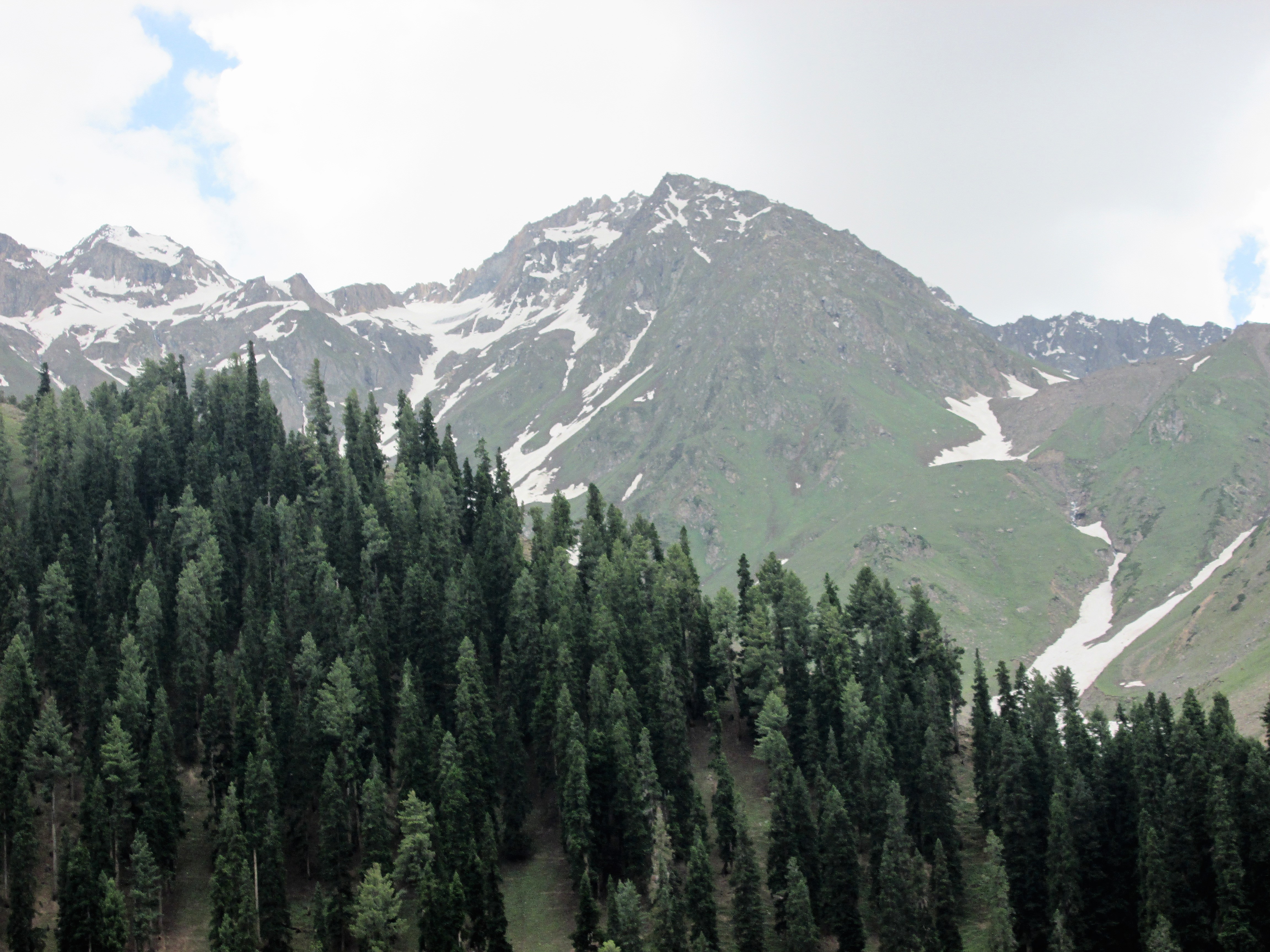
A mountain is a large landform that rises above the surrounding land in a limited area, usually in the form of a peak. A mountain is generally steeper than a hill. Mountains are formed through tectonic forces or volcanism. These forces can locally raise the surface of the earth. Mountains erode slowly through the action of rivers, weather conditions, and glaciers. Mountain environments cover some 27% of the world’s land surface, and directly support the 22% of the world’s people who live within mountain regions. Mountains provide for the freshwater needs of more than half of humanity, and are, in effect, the water towers of the world.
Mountains occur on all continents, in all latitude zones, and within all the world’s principal biome types – from hyper-arid hot desert and tropical forest to arid polar icecaps – and support a wide variety of ecosystems. Mountain ecosystems are important for biological diversity, particularly in the tropics and warmer temperate latitudes. Mountains are rich in flora and fauna .Mountains encourage sports like hang gliding, para gliding and river rafting.
Pakistan is blessed with a long range of mountains that are an attraction for geologists and mountain climbers from all over the world. Pakistan has more than a hundred peaks that are above 7,000 metres. Out of the world’s 14 highest peaks, four are in Pakistan. In the north-west there is a mountain range called Hindu Kush. This range is also present in Ghizar, Yasin Valley, and Ishkoman in Pakistans Northern Areas. Tirich Mir, located in Chitral (25,289 ft) is the highest point in the Hindu Kush range.
The Hindu Raj is located in the northern region of Pakistan, between the Hindu Kush and the Karakoram ranges. The Karakoram is a mountain range present in India, Pakistan, and China. The Karakoram range has more than 60 peaks which are above 7,000 metres (22,960 ft). This range includes K2, which is the second highest peak of the world standing at 8,611 metres (28,251 ft). Nanga Parbat is located at the western side of the Himalayas. It is situated in the Northern Areas of Pakistan, south of the Indus River in the Astore District. The Safed Koh or White Mountain range lies at the Pakistan-Afghanistan border. It ranges up to 4,761 metres (15,620 ft) above sea-level.
Kirthar Mountains are located in Sindh and Balochistan. The range extends southward for nearly 300km from the Mula River (Balochistan) to Cape Muari (west of Karachi) on the Arabian Sea. In Punjab there is a hill system called ‘The Salt Range’. It gets its name from the extensive rock salt deposits that are present in the area. This range lies across the northern province of Punjab, from the Jhelum River to the Indus. The famous salt mines of Khewra, Mayo, Warcha and Kalabagh are present in ‘The Salt Range’. The Sulaiman Mountains are located in northern Balochistan and Zabul province of Afghanistan. It is present at the border of the Indian Subcontinent and the Iranian Plateau and west of the Indus River. Takht-e-Sulaiman, meaning Solomon’s Throne with a height of 3,487 m (11,437 feet) in Balochistan is the highest peak of Sulaiman Mountains.
 View of Nature